A wedding photographer in Trichy just wrapped a 3-day event with over 4,000 photos. The plan, as always, was to upload everything to a shared Google Drive folder and send the link to the family. Halfway through the upload, the storage warning appeared - the account was nearly full, and the next tier meant paying for a Google Workspace upgrade just to finish handing over one event's photos. Meanwhile the couple's 400 wedding guests would still have to scroll through the same unsorted folder to find themselves, download a massive ZIP file on mobile data, and hope nothing failed halfway through.
This is the moment a lot of Indian photographers start looking for something else. Not because Google Drive is broken - it works fine for storing documents - but because it was never built for handing thousands of event photos to hundreds of people at once.
Here is why photographers are moving away from Google Drive for client delivery, and what they are switching to instead.
Why Google Drive Was Never Built for Event Photography
Google Drive is a general-purpose file storage tool. It was designed for sharing documents between a handful of people, not for delivering thousands of high-resolution images to hundreds of wedding guests, school parents, or corporate attendees. The cracks show up specifically at event scale:
- Storage that runs out mid-event. A single wedding can produce 3,000-5,000 final images. A busy season means several of these folders sitting in storage at once, and the free tier disappears fast.
- No way for guests to find themselves. A guest looking for their own photos has to scroll through the entire folder, image by image, hoping to spot themselves in a 4,000-photo dump.
- Zero studio branding. Every link says "Google Drive" at the top. The client's experience is tied to Google, not to the photographer who shot the event.
- No monetization. If a guest wants a physical print, Drive has no way to sell it to them. That's revenue the studio never collects.
The Real Problems Photographers Run Into
Storage Costs That Scale With Every Event
Google Workspace pricing increases with storage tier, and event photography eats storage fast. A studio shooting 15-20 events a month is either constantly upgrading its plan or deleting older client folders to make room - which means past clients lose access to photos they were promised would stay available.
Guests Give Up Before They Find Their Photos
This is the complaint photographers mention most. A parent at a school annual day, a guest at a 600-person wedding, a runner at a marathon - none of them want to scroll through thousands of unsorted images looking for the handful that include them. Most give up after the first few screens and never come back to check again, even though their photos are sitting right there in the folder.
No Branding, No Professional Impression
A Google Drive link looks the same whether it comes from a top studio or a hobbyist with a camera. There's no logo, no studio name, no way to reinforce the brand a photographer has spent years building. The delivery moment - often the last interaction a client has with the studio - ends up looking generic.
No Business Tools Attached
Drive stores files. It doesn't track who paid what, doesn't send invoices, and doesn't let a guest order a print. Everything past "here's your folder" - payments, follow-ups, print sales - has to happen somewhere else, usually WhatsApp and a notebook.
What a Dedicated Delivery Platform Does Instead
The photographers making the switch aren't moving to a bigger cloud drive - they're moving to a platform built specifically for event photo delivery, like MyPhotoStudio CRM. The difference shows up in four areas:
AI Face Search Instead of Endless Scrolling
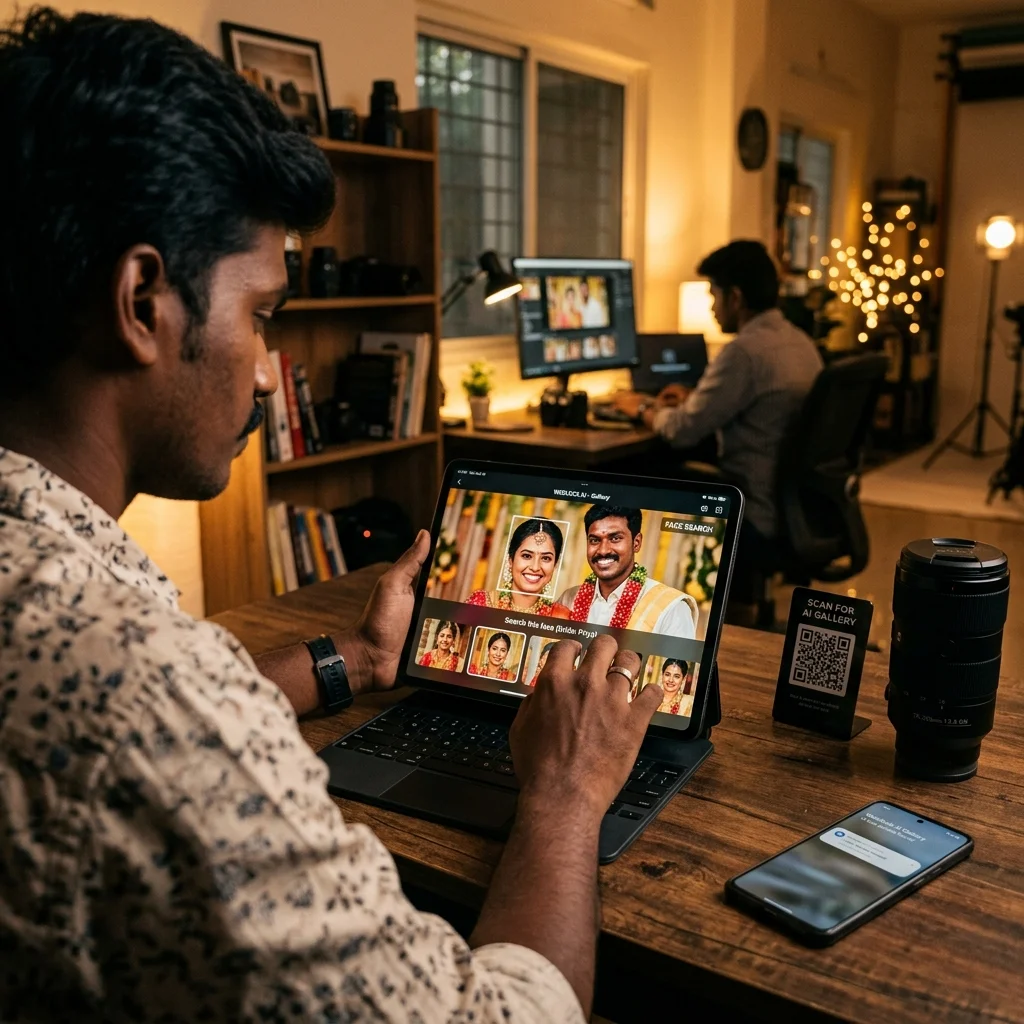
Guests scan a QR code, upload a selfie, and see only their own photos - pulled automatically from the full event gallery in seconds. There's no manual sorting on the photographer's side and no scrolling on the guest's side.
Branded, Mobile-First Galleries
Instead of a folder with a Google logo, clients get a gallery under the studio's own name and branding - logo, colors, contact details. It looks like a product the studio built, not a link borrowed from someone else's platform.
Print Orders Guests Can Actually Complete
A gallery that supports built-in print ordering turns "I wish I had a copy of this" into an actual sale - guests order and pay directly through the gallery via UPI, card, or net banking, with the payment going straight to the studio's account.
Flat, Predictable Per-Event Pricing
Rather than a storage bill that grows every few months, an event photo delivery platform like MyPhotoStudio CRM prices per event - starting at Rs.1,000 for a single event with unlimited photo uploads - so a studio can calculate its software cost per booking instead of watching a subscription creep upward.
The Hidden Cost of "Free" Storage
Google Drive's free tier looks like it costs nothing, which is exactly why so many studios default to it. But the real cost shows up in three places that don't appear on any invoice:
- Time spent managing folders. Renaming, organizing into sub-folders by event, and manually messaging guests when a link needs to be re-shared - this is unpaid admin work that happens on every single event.
- Support messages that never stop. "I can't find my photos," "the link isn't working," "can you send it again" - each one is a WhatsApp message the photographer has to personally answer instead of the gallery answering it automatically.
- Revenue that's never collected. Every guest who would have ordered a print but had no way to do it through the Drive link represents money the studio never sees, event after event.
None of this shows up as a monthly bill, which is exactly why it's easy to underestimate. A studio doing 15 events a month can lose several hours a week to folder admin and repeat "where's my link" messages alone - time that a branded, self-serve gallery removes almost entirely.
What This Looks Like in Practice
A studio in Coimbatore shooting a 500-guest wedding uploads the full event - ceremony, reception, candid shots - to a single event gallery instead of a Drive folder. The gallery link goes out over WhatsApp the moment the event is created. Guests scan the QR code printed on the venue signage, upload a selfie, and get every photo they appear in in about a second, without asking the photographer or the couple for help finding themselves.
A week later, several guests use the same gallery to order prints of their favorite shots - photos the studio would never have sold through a Drive link. The studio isn't managing a support queue of "can you resend the folder" messages, and storage isn't a line item they think about, because the event's photos don't count against a shared quota that also holds every other client's wedding.
The same pattern plays out at a school annual day with 800 parents in the audience. Instead of the school office fielding "which folder has my child's dance performance" questions for a week after the event, parents scan the QR code posted at the entrance, upload a selfie once, and get their own child's photos directly - no folder browsing, and no photographer fielding requests days after the event is over.
Switching Without Losing Past Client Galleries
One hesitation photographers raise is what happens to years of client galleries already sitting in Google Drive. The practical answer: nothing has to happen to them immediately. Existing Drive folders can stay live for past clients exactly as they are - there's no need to migrate historical events on day one. The switch happens going forward: the next new event gets set up on the new platform instead of a new Drive folder, and Drive is phased out naturally as older events age out of relevance rather than through a disruptive one-time migration.
When It's Worth Switching
Not every photographer needs to move immediately. A photographer shooting one or two small events a year, delivered to a handful of family members, may never hit Drive's real limitations. The switch becomes worth it once any of these become regular problems:
- Storage upgrades are a recurring cost instead of a one-time decision
- Guests regularly ask "which folder has my photos" or don't check the gallery at all
- Events routinely cross a few hundred guests - school functions, weddings, corporate events, marathons
- Print sales are being left on the table because there's no way to sell through the delivery link
For studios shooting regularly at that scale, a purpose-built Google Drive alternative for photographers replaces the storage bill, the endless scrolling, and the generic folder link with a branded gallery, AI face search, and print ordering - all from Rs.1,000 per event.
If the bigger issue isn't storage but managing bookings and payments around each event, see how top Indian studios handle client management without the WhatsApp-and-Excel chaos. And if WhatsApp itself has become the delivery method by default, here's how photographers are moving wedding photo delivery off WhatsApp entirely.
Still uploading events to a shared Google Drive folder?
Message us on WhatsApp and we'll show you how to set up your first branded event gallery with AI face search in under an hour.
WhatsApp UsRelated Reading
- How to Deliver Wedding Photos to Clients Without WhatsApp
- Photography Client Management - How Top Indian Studios Handle Bookings, Payments, and Deliveries
- Best Photography CRM Software India 2026 - Honest Comparison
- Google Drive Alternative for Photographers
Transform Your Photography Studio Today
Start automatically delivering thousands of event photos directly to your clients using MyPhotoStudio's AI Face Recognition - from ₹1,000 per event.
Start Free TrialLearn about our photography CRM software or view pricing plans.