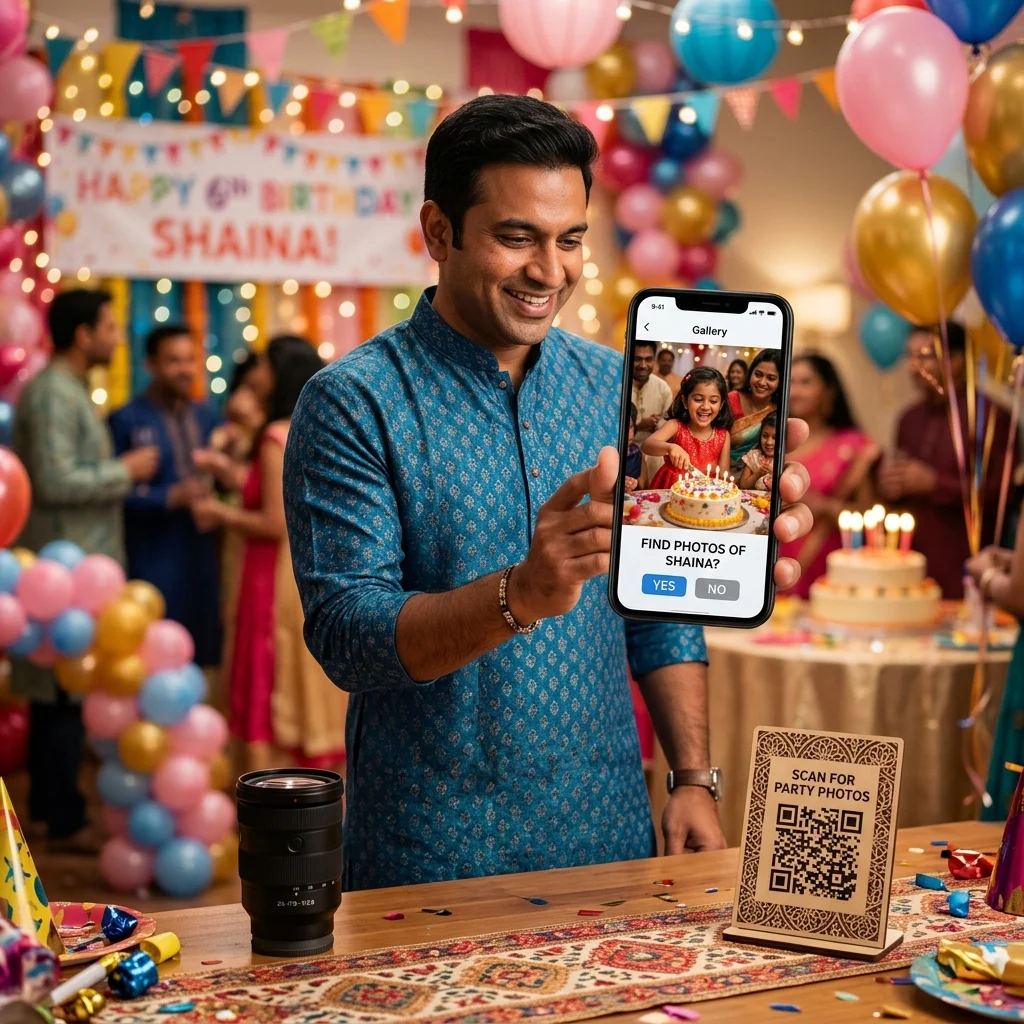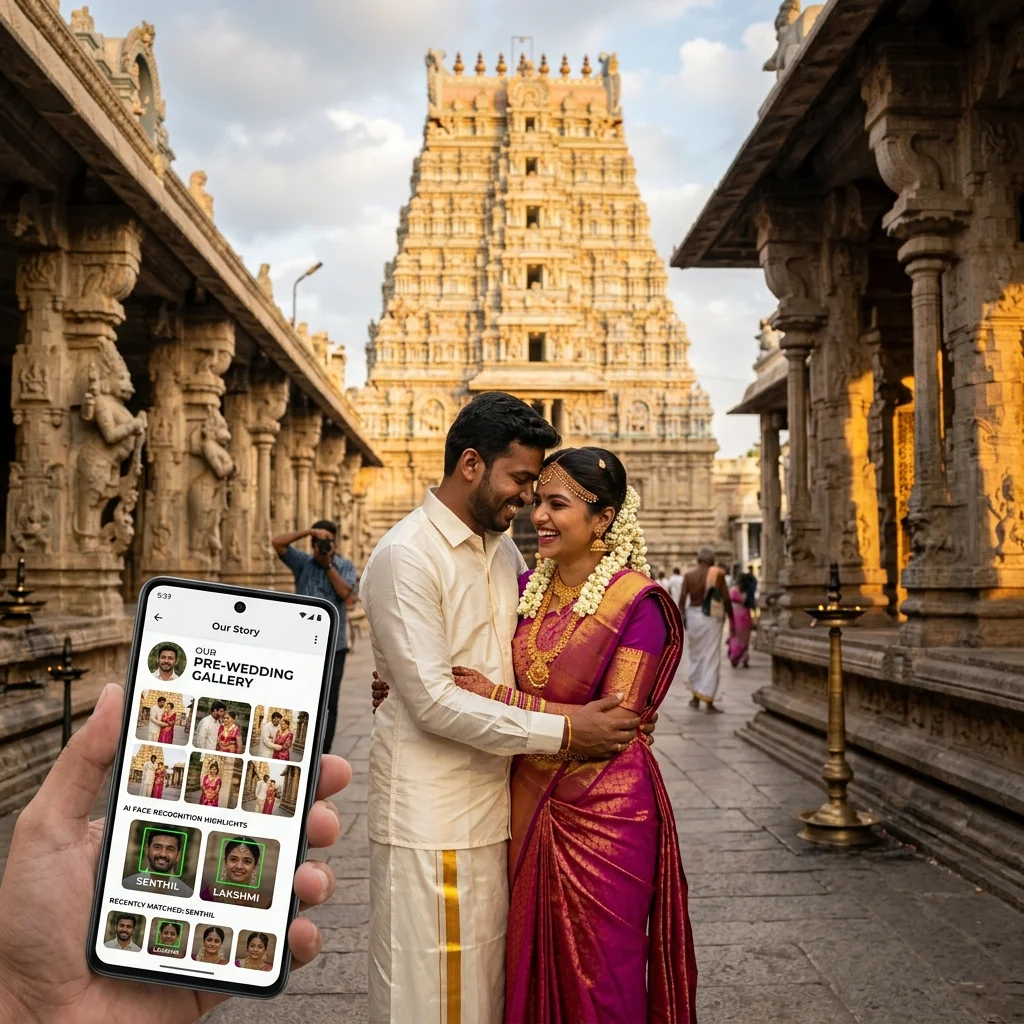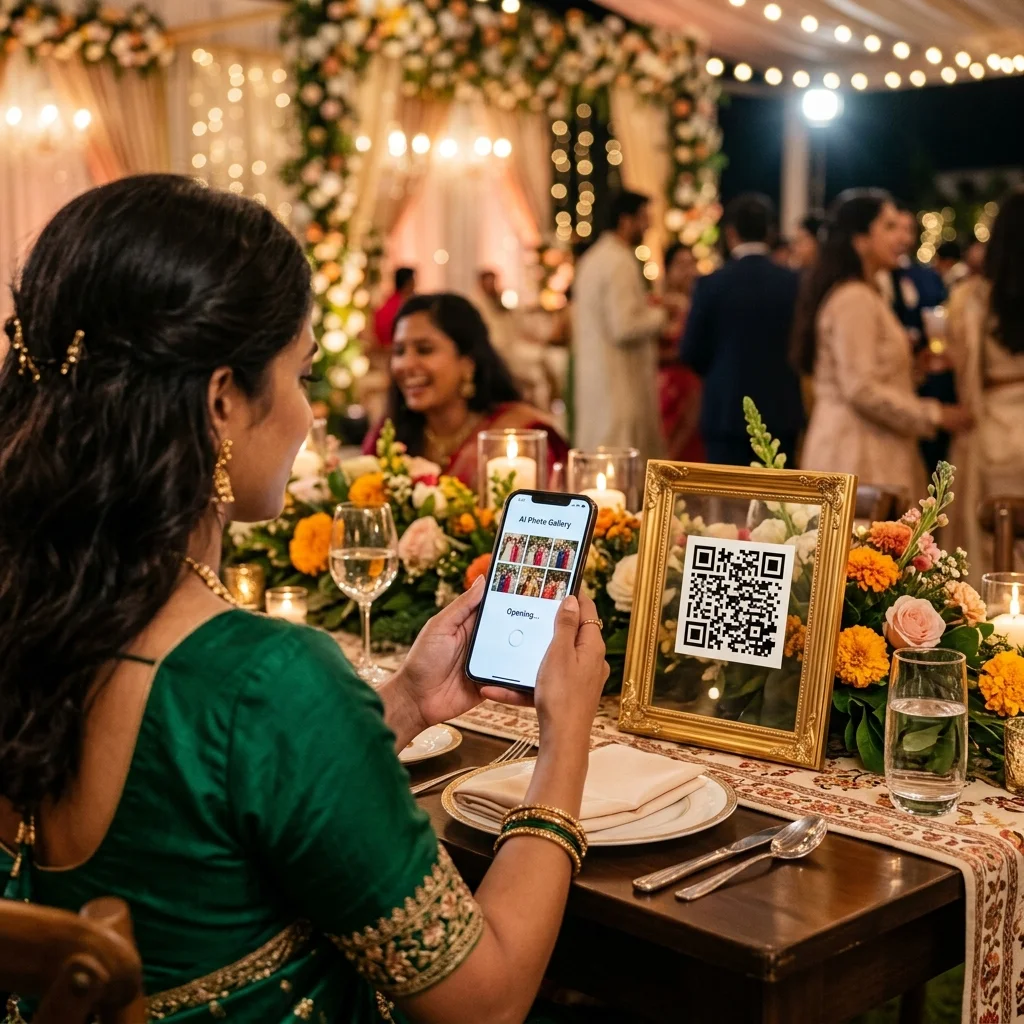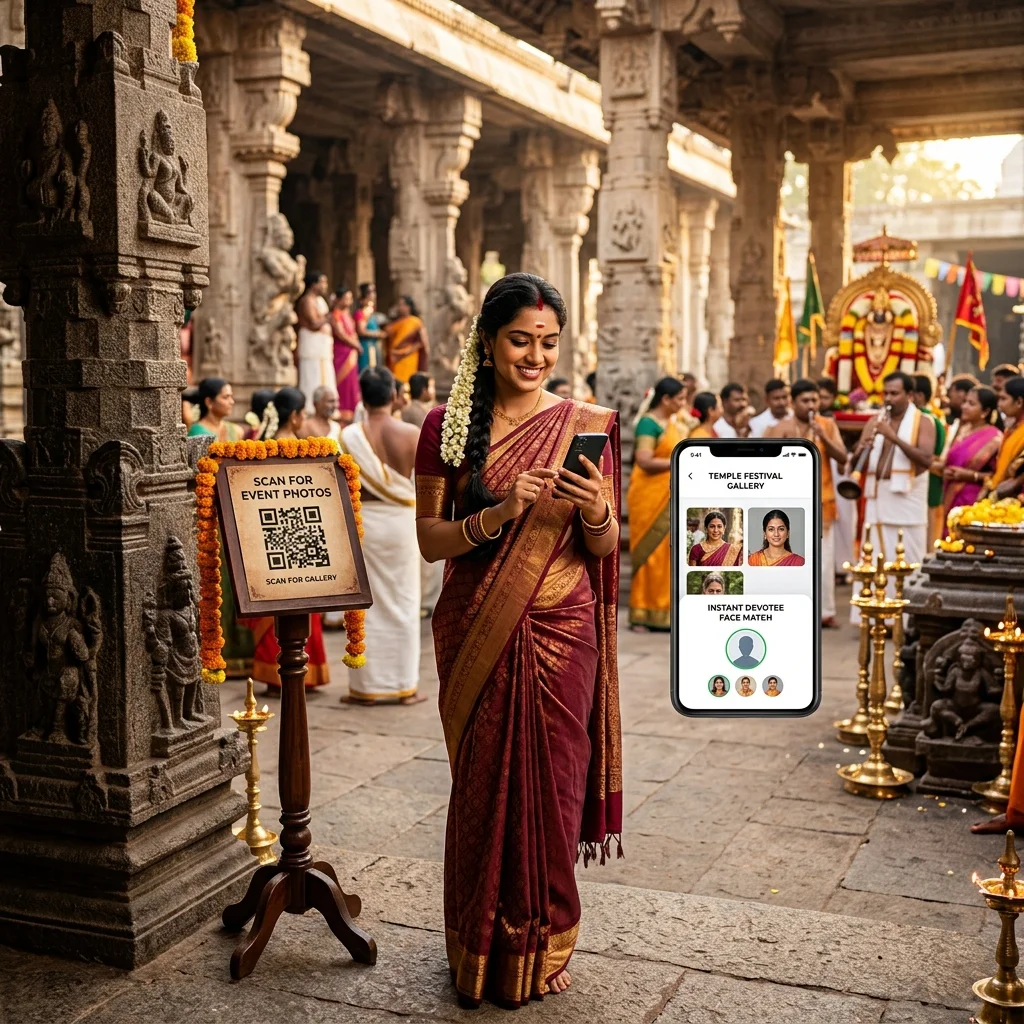

Temple event photo sharing is the use of AI face search and QR codes to let devotees and visitors find their own photos from a temple function or festival, without a guest list and without the photographer sorting images by hand. Temple events are one of the hardest photo-delivery problems in Indian event photography - crowds are large, mostly unregistered, and often spread across several days of a festival. This guide covers how AI photo sharing actually works for this specific setting, and what to check before using it at a temple event.
Table of Contents
- Why Temple Events Are a Different Photo-Sharing Problem
- How AI Face Search Works for Large, Unlisted Crowds
- How QR Codes Work at a Temple or Religious Event
- A Typical Workflow for Temple Event Photography
- Where This Fits - Festivals, Utsavams, and Everyday Temple Functions
- What to Check Before Using AI Photo Sharing at a Temple Event
- Privacy Considerations for Temple and Religious Events
- Where MyPhotoStudio Fits
- Frequently Asked Questions
Why Temple Events Are a Different Photo-Sharing Problem
A wedding or a corporate event usually has a guest list - the photographer, or the client, knows roughly who attended. Temple events rarely work this way. A festival day, an utsavam, or a family function held at a temple draws devotees, relatives, and visitors who were never formally invited or registered anywhere. Some arrive for a few minutes near the sanctum; others stay through the entire day.
This makes a shared photo folder or a WhatsApp group especially weak for temple events. There is no fixed group to add people to, and no way to know in advance who to send photos to. An AI photo sharing platform sidesteps this problem entirely - instead of the photographer trying to identify and reach every attendee, each person finds themselves.
The result is that temple event photo delivery does not depend on a guest list at all. Anyone who was at the event, whether or not the photographer ever spoke to them, can retrieve their own photos afterward using nothing more than the gallery link and a selfie.
How AI Face Search Works for Large, Unlisted Crowds
AI face recognition photo sharing works the same way for a temple event as it does for any other large gathering - the photographer uploads the full set of event photos, and the platform indexes every face automatically. No names, phone numbers, or guest information are required for this step, which matters at a temple event where that information often does not exist.
A visitor who wants their photos opens the gallery, takes a selfie in the browser, and sees only the photos they appear in - out of what can be a very large combined set from a multi-day festival. This is the same underlying technology referenced by AI face recognition photo delivery, applied to a setting where a guest list was never an option in the first place.
How QR Codes Work at a Temple or Religious Event
Because there is no guest list to work from, the QR code becomes the primary way people even learn that photos exist. A standee placed near the entrance, the mandapam, or a prasad distribution counter lets anyone who notices it scan the code and reach the gallery directly, at any point during the event or after.
QR code photo sharing works well here precisely because it needs no prior contact information - a person who was never registered anywhere can still find the code, scan it, and search for their own photos. This is the same reason QR-based access works for weddings and corporate events, applied to a crowd that is, by nature, far less predictable.
A Typical Workflow for Temple Event Photography
Upload
After the event, the photographer uploads the complete set of photos - across a single function or multiple festival days - to the platform in one or more batches. This remains the only manual step in the process.
Display the QR Code at the Venue
A QR code standee is placed at a visible spot near the event - entrance, mandapam, or a common gathering point - so that anyone attending can scan it independently, without needing to be approached or added to a list.
Guests Search With a Selfie
Each visitor scans the code on their own phone, takes a selfie in the browser, and receives their personalised set of matching photos. This can happen during the event itself or days later, and works the same way for a five-minute visitor as it does for someone who attended the full day.
Delivery
From the personalised gallery, visitors can view and, where enabled, download their own photos directly - without contacting the photographer individually. For a large festival with hundreds of attendees, this removes what would otherwise be an unmanageable number of individual requests.
Where This Fits - Festivals, Utsavams, and Everyday Temple Functions
Temple event photo sharing applies across a range of settings, from a single-day family function held at a temple to a multi-day public festival:
Temple utsavams and festival days often draw the largest and least predictable crowds of any event type a photographer covers - visitors arrive and leave throughout the day, across several days, with no way to track who attended. Face search lets each person find their own photos regardless of when they showed up.
Family functions held at a temple - naming ceremonies, upanayanams, or other rituals - usually involve a smaller, partly-known group of relatives, but still benefit from guests being able to retrieve their own photos without waiting for the photographer to sort and send them individually.
Community and public religious gatherings that are open to anyone, with no registration at all, are the clearest case for QR-based, list-free photo delivery - there was never a list to build in the first place.
What to Check Before Using AI Photo Sharing at a Temple Event
Temple events put a few specific demands on an AI photo sharing platform that a smaller, guest-list-based event does not. Worth confirming before a festival day:
| What to Check | Why It Matters at a Temple Event |
|---|---|
| Performance with a large, growing gallery | A multi-day festival can produce a very large combined photo set - ask how the platform performs as the gallery grows across the event, not just on a single day. |
| No-registration guest access | Since there is usually no guest list, confirm guests can search using only a selfie, with no sign-up or phone number required. |
| QR code durability at the venue | A standee needs to survive a busy, outdoor or semi-outdoor setting for the length of the event - ask about printable formats suited to this. |
| Guest access method | Confirm guests can reach the gallery from a standard mobile browser, without installing an app, since a temple crowd will not do so reliably. |
| Privacy and data handling | Ask directly how selfie and face data is handled for a public, open-access event where visitors were never formally registered. |
Privacy Considerations for Temple and Religious Events
Temple and religious events are typically open to the public, which makes privacy a more relevant question than at a private, invite-only function. Because guests were never registered anywhere, it is worth confirming that each visitor only sees the photos they personally appear in, rather than a full, browsable gallery of everyone present.
This article does not make specific legal or compliance claims on behalf of any platform, since data-handling practices vary by provider. Photographers organising photo delivery for a temple or religious event should confirm retention and data-handling details directly with whichever platform they use, rather than assuming a default - particularly given how open access to the event itself typically is.
It is also reasonable to ask whether a visitor's selfie is used for anything beyond matching photos from that specific event, and whether it is deleted or retained afterward. This is a fair question to raise with any platform before a festival day, not an afterthought once the event is already underway.
Where MyPhotoStudio Fits
MyPhotoStudio's temple event photo sharing setup uses the same AI face recognition and QR code delivery described above, built for a setting where a guest list is rarely available - guests access their photos through a standard mobile browser, with no app required. Photographers who also need to track bookings or payments across temple and other event types can use the platform's studio-management features as a supporting layer, alongside the core AI + QR photo delivery workflow.
Frequently Asked Questions
What is temple event photo sharing?
Temple event photo sharing is the use of AI face recognition and QR codes to let visitors and devotees find and retrieve their own photos from a temple function or festival, without a guest list or manual sorting by the photographer.
How does AI photo sharing work at temple events?
The photographer uploads all event photos once. The platform indexes every face automatically. Visitors then scan a QR code, take a selfie, and see only the photos they appear in - with no names, phone numbers, or guest list needed at any step.
Do guests need to be on a list to find their photos?
No. Because face search matches a selfie directly against the uploaded photos, anyone who attended can search for their own photos, whether or not they were ever registered or added to a guest list.
How does a QR code work at a temple function with no formal guest list?
A QR code standee placed at the venue - near the entrance, mandapam, or a common gathering point - lets any visitor scan it and reach the gallery directly, without needing to be identified or approached by the photographer first.
Is an app required for guests to view or download photos?
On MyPhotoStudio, no - the gallery, selfie search, and photo access all run inside a standard mobile browser, without requiring guests to download an app.
Can photos be accessed across a multi-day festival, not just after it ends?
Yes - once a batch of photos is uploaded, guests can scan the QR code and search for their photos at any point, including during the event itself, without waiting for the entire festival to conclude.
Is guest face or selfie data stored permanently?
No. Guest face data is not retained permanently after the event's retention period ends. Photographers should confirm the specific retention details with their platform before a temple event.
See how MyPhotoStudio handles temple event photo sharing or view pricing plans to see what's included per event.
Transform Your Photography Studio Today
Start automatically delivering thousands of event photos directly to your clients using MyPhotoStudio's AI Face Recognition - from ₹1,000 per event.
Start Free TrialExplore our AI photo sharing platform, learn about our photography CRM software, or view pricing plans.